BackOps AI
Platform
Customers
Integrations
Resources
Company
Login
Book a Demo

Why better automation starts with a better process
In supply chain, the process written down on paper is often rooted in workflows designed years or even decades ago. Since then, new systems, customer requirements, workarounds, and exceptions have changed how the work actually gets done. Some changes make it into a formal process, but a lot stays with the people who know which portal to check, which rule to override, and what to do when the normal path breaks.
That matters more now that general-purpose AI has made building much more attractive in the buy-vs-build decision. Teams can increasingly use tools like ChatGPT or Claude to automate many of these tasks on their own. For straightforward use cases, that may be all they need. The bigger risk is assuming the process they are automating is the right process to begin with.
How the process actually works
A temperature breach claim in a cold-chain operation is a good example. On paper, the workflow might say to validate the temperature excursion, collect the evidence, file a carrier claim, and determine the appropriate customer resolution.
In practice, the work is rarely that simple. One person knows which temperature record to trust. Someone else knows that a particular carrier expects different documents. Another employee knows when the customer should be reshipped immediately rather than waiting for the claim to work its way through. Those decisions are part of the process, even if they never made it into the SOP.
BackOps starts by mapping how the work actually moves from the initial event to resolution. We look at where people wait, where information gets lost, which handoffs are necessary, and which steps exist because teams learned to work around an old system or policy. The real process is often different from the documented one. Information needed early may not be collected until much later. Two teams may be doing versions of the same work. A step that once made sense may still be there simply because nobody removed it. Automating that process as-is may save time, but it can also lock inefficiencies into the new workflow.
Where supply chain data changes the answer
Once we understand how the work really happens, we can ask a more useful question: is there a better way to run it? The answer can depend on the carrier, product, customer, facility, claim type, evidence available, or what has already happened in the case. In the temperature breach example, the existing process might finish the claim investigation before deciding what to do for the customer. Looking at the actual workflow may show that, for certain products or customers, waiting creates unnecessary service risk. A better process could start the customer resolution earlier while the financial claim continues separately.
The point is not that this is the right workflow for every temperature breach. It is that the current SOP should not automatically become the blueprint for automation. BackOps combines what we learn from the customer's operation with supply-chain-specific data and experience to improve the workflow itself. Depending on the process, that may mean faster resolution, higher throughput, better SLA performance, fewer escalations, or fewer manual touches. The goal is not to simply automate the current process, but to identify an optimized and more efficient version that drives better results.
Automation is part of the answer. Improving the process is where the real value comes from
We apply proprietary supply chain process knowledge and data to identify where a workflow can be improved before BackOps’ AI platform, Relay, runs it. That may mean changing the sequence of steps, removing unnecessary handoffs, handling exceptions differently, or making different decisions based on the carrier, customer, product, facility, or claim type.
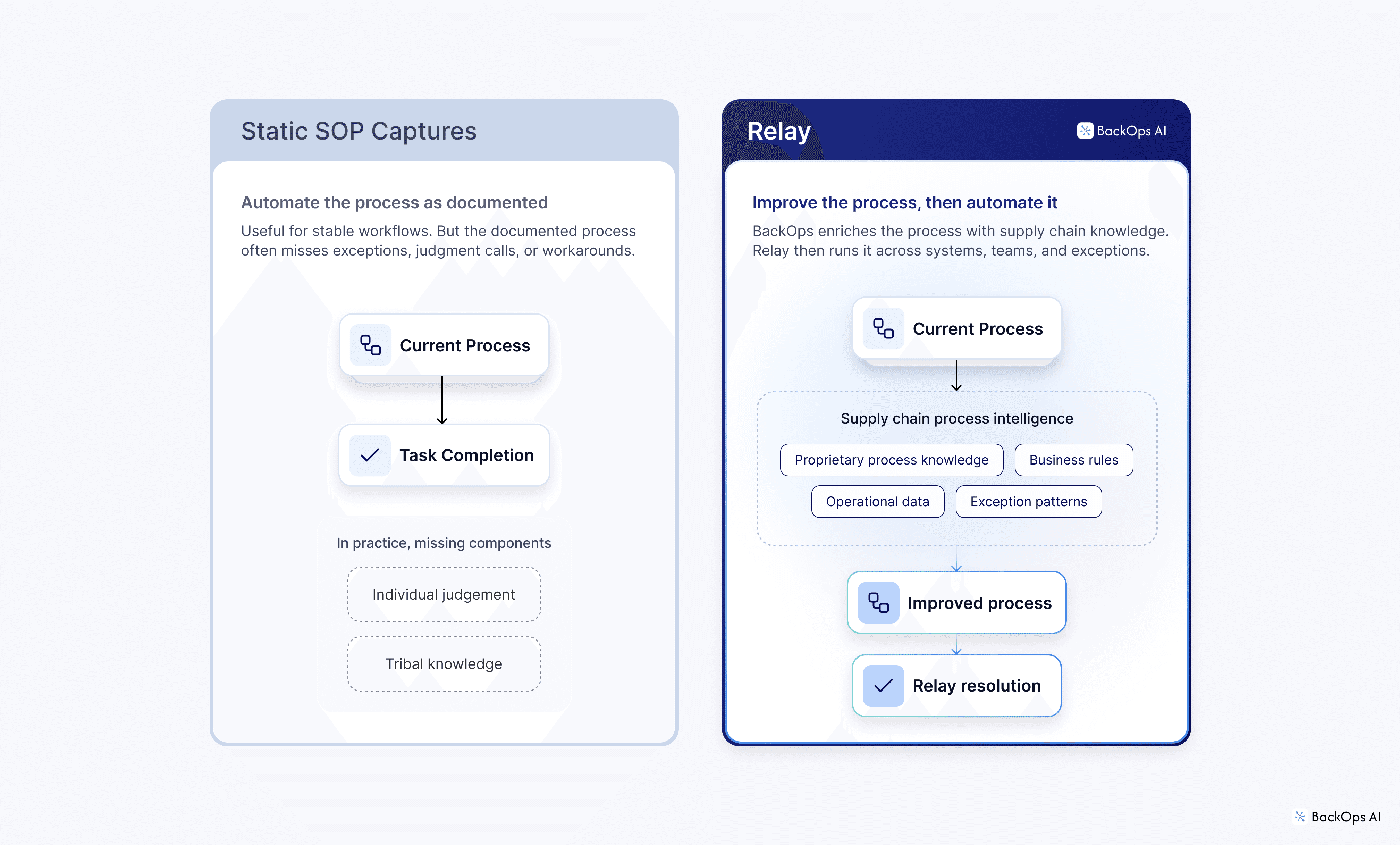
Relay then runs that improved workflow across the systems where the work actually happens. It can collect information, apply business rules, work across internal systems and external portals, track unresolved cases, and bring in a person when judgement is required. If new information arrives later, the workflow continues with the history and context already in place.
The process also keeps changing. Data sources and formats evolve, systems get replaced, and new requirements are added even when the underlying business need stays the same. Running the workflow gives BackOps new information about where work slows down, where exceptions repeat, and where the process can improve again.
Know what to build and what to buy
Not every AI workflow needs a purpose-built platform. Research, document analysis, drafting, one-time data work, and straightforward automations will continue to get easier and cheaper with general-purpose AI. If ChatGPT or Claude can handle a task well, companies should take advantage of that. But much of this work will become commoditized.
While building the automation may be easy, figuring out the right process to automate is the harder problem. If the process needs to be discovered first, if supply chain data can improve how it runs, or if the work has to move reliably across systems, exceptions, and human decisions, then there is more to solve than building a stand-alone agent.
That is where BackOps is focused. We work with customers to understand how the operation actually runs, identify where the process can be improved, and then use Relay to automate that better version. So if you are deciding whether to build or buy, start with the process. Are you confident the workflow you have today is the one you want to automate?
If the answer is no, that is the problem to solve first.
If you're deciding whether to build or buy, bring us the workflow. We'll help you identify what should be automated, what should change first, and whether Relay is the right fit